The Right to Hear

By Judith Fisher
My hearing loss journey didn’t start with a sudden bang.
It started with a whisper so quiet I didn’t even notice it. Our brains are incredibly clever; they compensate.
Bu by the time I reached my early 50s, my brain’s coping mechanisms had reached their limit.
At the time, I spent about 30% of my working day talking on the phone. And these weren’t quiet office calls. I was dealing with farmers driving noisy tractors using dodgy mobile connections, and fishermen on trawlers out in the Gulf of Carpentaria using crackly satellite phones.
With no visual cues or lips to read, I was becoming reliant on context. If the customer changed the subject, I was often at sea – constantly apologising and asking them to repeat themselves.
These calls became mentally exhausting. Even back in the office, I noticed that if a colleague stood where I couldn’t see their whole face, I couldn’t hear them. I struggled terribly in meetings.
On the advice of my ENT I sought help at the UQ Audiology Department and was fitted with my first hearing aid in my left ear. Three years later, I got my second for the right ear.
Eventually, I upgraded to a matching pair of Siemens hearing aids equipped with T-coil technology that, supposedly, would enable them to connect automatically to my standard work telephone. Sadly, the technology just wasn’t there yet. The line would drop in and out, adding a whole new layer of frustration to already dodgy phone lines.
Alongside the hearing loss, I also experienced ongoing problems with my left ear, including repeated infections and, eventually, surgery to repair my eardrum. By the time I retired from work in 2019, I was determined to do everything I could to get the best out of my remaining hearing.
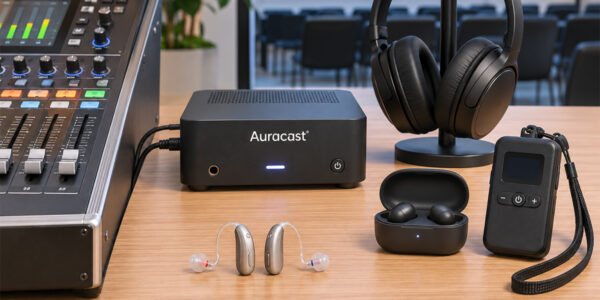
I had been searching the internet for answers. Eventually, I came across the BHA Brisbane website. That was a game changer! There I discovered their hearing support groups. I attended meetings where I learned about assistive listening devices and learned some strategies to help me in noisy situations.
But the most important thing I found was something I hadn’t expected—other people who understood.
I didn’t have to explain why a noisy restaurant could be exhausting, why I sometimes missed the punchline of a joke, or why following a group conversation took so much concentration. In a support group, you are not the only person struggling to keep up.
Through the BHA website I discovered the Active Communication Education (ACE) program and eventually I was able to attend one run through the audiology department at UQ. Through BHA I was also involved in the pilot study for a newer version of the ACE program. Through BHA I joined a lip-reading group to help build on my existing lip-reading skills.
Recently I’ve been learning Auslan through Deaf Connect. Although I doubt I will ever be a fluent Auslan user I have been enjoying the process and the interaction with other students.
I recently discovered through Ellen at BHA that, as someone over 65, I can access a captioner at no cost to support me at meetings. I’ve now organised for a captioner to attend my local Probus club meetings, which makes it much easier for me to follow and participate.
With support and encouragement from Ellen at BHA I’m now facilitating my own hearing loss support group in Toowong. For me, that really demonstrates the value of peer support. As someone who once came looking for information and encouragement, I am now able to offer some of that same support to other people.
What I particularly valued was that Better Hearing Australia wasn’t trying to sell me a particular hearing aid or product. I could ask questions, find practical information and learn about the range of options available to me. That independence matters when you are trying to make sense of a condition that can sometimes feel overwhelming.
Through Better Hearing Australia, I learned that living well with hearing loss is about much more than hearing aids. It is about having access to independent information, practical strategies and new technology. But just as importantly, it is about connection—meeting people who understand, learning from one another and knowing that you are not alone.
I have learned that we all have a fundamental right to communicate—to participate socially, to contribute in the workplace and to remain connected to the people around us. I learned to advocate for myself.
Hearing loss is a journey. There will always be new challenges, but there will also be new possibilities. Thanks to the information, encouragement and support I have received through Better Hearing Australia, I feel much better equipped to navigate that journey.
And now, through facilitating a support group myself, I hope to pass some of that support on to others.
I can’t change my hearing loss, but I hope that, with the continued support of BHA, I will continue to gain the wisdom to live well with my hearing loss.
Judith Fisher delivered the above presentation on 9th October 2026 at the Past Present Future event co-hosted by BHA and The University of Queensland, celebrating 80 Years of BHA.