How Auracast Could Make Everyday Hearing Easier

From meeting rooms and community centres to theatres and public transport, Auracast could make it easier for people with hearing loss to hear, connect and take part.
Imagine sitting in a community meeting and hearing every word from the speaker, even at the back of the room. Or joining a workplace discussion without struggling to hear over background noise.
A new technology called Auracast™ could help make this possible.
Better Hearing Australia (BHA) first explored the hope, hype and hurdles of Auracast in May 2025. We also published our position on Auracast and hearing accessibility, welcoming the technology while calling for existing hearing systems to be protected.
Since then, Auracast has continued to develop. More hearing aids now support it, and venues around the world are starting to use it.
But what does this mean for you?
The exciting part isn’t just what Auracast can do in large theatres or airports. It’s how it could help people hear better in the places they visit every day.
What is Auracast and how does it work?
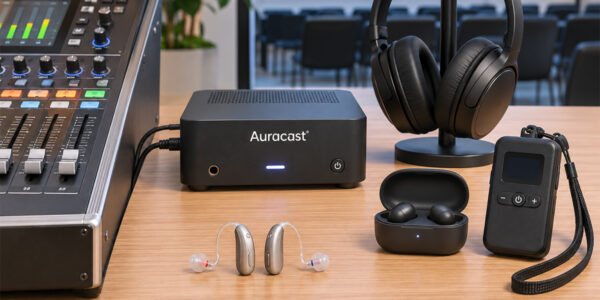
Auracast is a type of Bluetooth technology. It sends sound wirelessly from a microphone, television or sound system to many listeners at once.
Think of it like tuning into a radio station.
A small device called a transmitter sends out the sound. People nearby can listen using compatible hearing aids, headphones, earbuds or other receiving devices.
Here’s how it could work at a community meeting:
- A speaker talks into a microphone.
- An Auracast transmitter sends their voice across the room.
- People with compatible devices choose the broadcast and listen.
- Each person can adjust their own listening volume.
Everyone else can still hear through the room’s normal speakers.
The main benefit is simple. Sound goes directly to your listening device, rather than travelling across a noisy room.
This can make speech easier to understand, especially when there is background noise or the speaker is far away.
Unlike many older Bluetooth systems, Auracast doesn’t need to pair with each listener separately.
It also doesn’t need an internet connection.
Learn more about how Auracast works.
Who can benefit from Auracast?
Auracast was designed for a wide range of people, not just those who wear hearing aids.
People with hearing loss
For someone who wears compatible hearing aids, Auracast may provide clearer speech during presentations, meetings or performances.
It could also reduce the effort needed to follow a conversation.
People with cochlear implants
Some cochlear implant systems can receive Auracast directly or through an extra device. This depends on the model and the equipment being used.
People with mild hearing difficulties
You don’t need to wear hearing aids to benefit.
Some people find busy places difficult to hear in, even if they haven’t been diagnosed with hearing loss. Compatible earbuds or headphones may help them hear more clearly.
People who use older hearing aids
Not everyone will have Auracast-ready hearing aids.
Some people may be able to use a separate receiver with headphones or a neckloop. A neckloop sends sound to hearing aids fitted with a small receiver called a telecoil.
This is important because people shouldn’t have to buy new hearing aids just to attend a meeting or enjoy a public event.
Check with your hearing health professional what technology you have access to in your device and how to use it.
Where could Auracast make a difference?
While Auracast is being introduced in large public venues, some of its most useful applications could be in smaller spaces.
Office meeting rooms
Think about a meeting with ten people sitting around a table.
A person with hearing loss may hear the colleague beside them but struggle to follow someone at the other end.
Auracast could send sound from the room’s microphones directly to compatible hearing aids or headphones.
This may help staff take part more fully in meetings, training and presentations.
It could also be useful in hybrid meetings, where some people attend online and others are in the room.
However, the microphones need to pick up everyone’s voice. A system connected only to the main speaker’s microphone won’t capture every conversation around the table.
Good meeting practices, clear speech and suitable microphones still matter.
Community groups and clubs
Community groups are one of the most promising uses for Auracast.
Consider a seniors’ group, RSL club, sporting association or local committee holding its monthly meeting.
These meetings often take place in rooms with hard floors, background noise and poor sound quality.
A portable Auracast transmitter could connect to a microphone or the room’s existing sound system.
Members with compatible devices could then hear the speaker more clearly, wherever they choose to sit within the broadcast area.
The same portable equipment might also be used for meetings in different locations.
For smaller groups, this could offer a more affordable way to improve hearing access.
Libraries and community centres
Libraries, council buildings and community centres host talks, workshops and public meetings.
Yet many of these rooms have no hearing support system.
Auracast could make it easier for people to hear guest speakers, training sessions and public discussions.
For organisations trying to make their events more inclusive, it could be a practical option worth exploring.
Churches and places of worship
Many places of worship have high ceilings and hard surfaces that cause sound to echo.
This can make speech difficult to understand, even when the sound system is loud.
Auracast can send sound directly from the venue’s microphones or audio system to compatible listening devices.
This could help people follow services without needing to sit close to the speakers.
Waiting rooms and shared spaces
Imagine being able to hear the television in a medical waiting room through your own headphones.
Or listening to a sporting event at a club without the television being turned up for everyone.
Auracast could make this possible in many shared spaces.
It also offers opportunities in aged care, where residents may want to listen to television or take part in group activities at a volume that suits them.
Auracast in action: Examples from Australia
Auracast is already being used in Australian theatres, universities and community spaces. These examples show how it can work and how it could improve hearing access in more places.
Sydney Opera House: Making live performances more accessible
The Sydney Opera House began introducing Auracast in 2025. By August 2026, the technology was available in all seven indoor performance spaces.
Visitors with compatible hearing aids or earbuds can listen directly to performances, wherever they sit.
Those without compatible devices can borrow a receiver with headphones or a personal hearing loop.
Importantly, the Opera House continues to offer traditional hearing loops in designated seating areas.
This shows how new technology can improve hearing access while keeping existing systems available for people who rely on them.
Read the Sydney Opera House case study.
University of Queensland: Making lectures easier to hear
The University of Queensland has introduced Auracast in 65 lecture theatres across its campuses.
The technology allows students to hear lecturers directly through compatible hearing aids or headphones.
Each lecture theatre has a QR code explaining how to connect. Students without suitable devices can also borrow listening equipment.
UQ has found that the technology can benefit more than people with hearing loss. Some students who speak English as second language also find listening easier.
This is a useful example of how Auracast could improve hearing access in classrooms, workplaces and community meeting rooms.
Read the University of Queensland announcement.
Bolton Clarke, Brisbane: Helping older Australians stay connected
In May 2026, retirement living provider Bolton Clarke launched an Auracast program at its Carrington retirement village in Brisbane.
Working with Australian company Audeara, the organisation plans to introduce the technology across 43 retirement villages nationally.
The aim is to help residents hear more clearly during social events, presentations and group activities.
Bolton Clarke’s research found that 45% of surveyed village residents were affected by hearing loss.
The project shows how Auracast could help older Australians stay connected and take part in community life. The wider rollout is planned, with results yet to be reported.
Read the Bolton Clarke announcement.
Federation Square, Melbourne: Improving access in an older building
The Edge at Melbourne’s Federation Square hosts talks, performances and community events for up to 450 people.
When its existing hearing loop stopped working, the venue needed a new way to provide hearing access.
Installing another loop was difficult because of the building’s heritage protections.
Instead, the venue introduced Auracast, connecting it to the existing sound system without major building work.
Visitors can listen using compatible devices or borrow receivers and headphones.
This shows how Auracast could help older buildings and community facilities where installing traditional hearing loops may be difficult.
Read the Federation Square case study.
Queensland Performing Arts Centre: More choice for theatre audiences
The Queensland Performing Arts Centre (QPAC) in Brisbane now provides Auracast in four performance spaces.
These include the Lyric Theatre, Concert Hall, Glasshouse Theatre and Playhouse.
Visitors with compatible hearing aids can receive the sound directly, while others can borrow a receiver with headphones or a personal induction loop.
QPAC also provides other hearing support systems for people using telecoil-equipped hearing aids or cochlear implants.
This gives audiences more ways to enjoy live performances and shows how Auracast is already becoming available in Queensland.
Read QPAC’s hearing accessibility information.
City Recital Hall, Sydney: Bringing clearer sound to live music
Sydney’s City Recital Hall introduced Auracast in September 2025 to improve hearing access for audiences.
The system sends sound directly from the theatre’s audio equipment to compatible hearing aids, headphones and other listening devices.
Visitors without compatible equipment can borrow a receiver from the venue.
The project received support from the NSW Government through Sound NSW.
It shows how established venues can introduce Auracast to give more people the opportunity to enjoy live music and performances.
Read City Recital Hall’s accessibility information.
ICC Sydney: Supporting accessible conferences and events
ICC Sydney has introduced Auracast-based hearing support in several of its major event spaces.
These include the Grand Ballroom, Darling Harbour Theatre, Pyrmont Theatre and TikTok Entertainment Centre.
Visitors with compatible hearing aids or headphones can connect directly to the venue’s broadcasts.
Those without compatible devices can borrow a receiver and use headphones or a neckloop.
This is a useful example for organisations that run conferences, meetings and presentations.
It shows how Auracast can help people take part in large events without having to rely on the sound coming from speakers across the room.
Read ICC Sydney’s accessibility information.
Australian public transport: Testing clearer passenger announcements
Auracast is also being tested as a way to help people hear important announcements on public transport.
An Australian research project reported in October 2026 included 19 structured trials at Melbourne Airport, on Melbourne bus services and at a Canberra transport interchange.
Participants tested how Auracast could provide information such as departure times, bus stops, route changes and assistance messages.
The research found that the technology showed promise for making passenger information more accessible.
These were trials rather than permanent public installations, but they could help guide future transport improvements.
Read the iMOVE Australia research findings.
How much does Auracast cost to install?
One of Auracast’s biggest attractions is that it can make hearing access easier and potentially more affordable to install, particularly in existing buildings.
Unlike traditional hearing loops, which usually require cables to be installed around or throughout a room, Auracast broadcasts sound wirelessly. This can reduce the need for building work and make it an attractive option for offices, community centres and other venues.
However, not all Auracast systems are the same. Equipment ranges from simple consumer-grade devices to professional systems designed for large theatres, conference centres and public buildings.
Small meeting rooms and community spaces
For smaller spaces, the setup can be relatively simple.
A portable or consumer-grade Auracast transmitter may be all that’s needed if the room already has suitable microphones or sound equipment.
In some cases, the transmitter can connect directly to an existing audio system, with little or no building work required.
This makes Auracast particularly appealing for community groups, clubs, meeting rooms and organisations with limited budgets.
Venues may also choose to provide loan receivers, headphones or neckloops for people who don’t have compatible devices.
Theatres, conference centres and larger venues
Larger spaces need a more advanced approach.
Professional-grade Auracast systems are designed to work with existing audiovisual equipment and provide reliable sound across larger or more complex areas.
A theatre, for example, may need several transmitters to reach different seating areas, including balconies. Conference centres may need separate broadcasts for different rooms or events.
These installations require more planning, specialist equipment and testing, so costs will generally be higher than for a small meeting room.
However, Auracast may still offer installation advantages over traditional hearing loops.
How does Auracast compare with hearing loops?
Traditional hearing loops remain an effective and important form of hearing support.
However, installing a new loop can involve running cables beneath flooring, around walls or through other parts of a building. This can be difficult or costly in older buildings, heritage-listed properties or venues with complex layouts.
Metal structures and electrical interference can also affect loop performance, sometimes requiring more specialised equipment and installation.
Auracast avoids much of this cabling, although professional installations still need careful planning to ensure reliable wireless coverage.
The total cost depends on the space, existing equipment, installation requirements and the number of loan receivers needed.
And while Auracast provides new opportunities, BHA supports retaining effective hearing loops for people who still rely on them.
The key benefit is choice. Auracast could make hearing augmentation more practical and affordable for smaller organisations, while providing another accessibility option for larger venues.
As with any hearing augmentation system, organisations should seek appropriate advice to ensure their installation meets Australian building accessibility requirements and works for the people who need it.
Will I need to buy new hearing aids?
Not necessarily.
Some newer hearing aids can already receive Auracast broadcasts. Others may need an update or an extra device.
In October 2026, Bluetooth announced that all five major hearing aid manufacturers now offer models that support Auracast.
These include Sonova, Demant, GN, WS Audiology and Starkey.
This is an important step, but it doesn’t mean every hearing aid made by these companies will work with Auracast.
Read the Bluetooth announcement.
If you’re considering new hearing aids, ask your audiologist:
- Does this model support Auracast?
- Can it connect directly, or will I need another device?
- Will I need a smartphone to find and select broadcasts?
- Is Auracast available now, or will it need a future update?
Don’t assume your hearing aids support Auracast simply because they connect to your phone using Bluetooth.
You can also explore the official list of Auracast products.
When will Auracast be widely available in Australia?
Auracast is being introduced step by step.
Compatible devices are already on sale, and some Australian venues are starting to use the technology.
Queensland’s Department of Education has also included Auracast in its June 2026 technical guide for hearing support in schools.
This shows growing interest in using the technology in public buildings.
But it will take time before people can expect Auracast to be available wherever they go.
Venues need suitable equipment. People need compatible listening devices. Staff also need to know how to help visitors connect.
There is no single date when Auracast will become available across Australia.
For now, it’s best to check with a venue before visiting if you need a hearing support system.
Will Auracast replace hearing loops?
This is an important question, particularly for people who already rely on hearing loops.
A hearing loop sends sound directly to hearing aids or cochlear implants fitted with a telecoil.
These systems have been used for many years and remain an important part of hearing access.
Auracast offers new benefits, including the ability to work with a wider range of compatible headphones and earbuds.
But many people with hearing loss don’t yet own devices that can receive it.
BHA supports keeping effective hearing loops while introducing Auracast where it can improve access.
This is sometimes called a dual-technology approach.
It gives people more choice and helps prevent anyone being left behind.
In a community hall with no hearing support, Auracast might be a useful new option.
In a theatre with a working hearing loop, adding Auracast could offer another way to listen without taking away existing access.
The right solution will depend on the venue, the people using it and any legal access requirements.
Read more about BHA’s position on Auracast and hearing accessibility.
What should businesses and community groups consider?
If you’re thinking about Auracast for your workplace, meeting room or community venue, start with the people who use the space.
Ask where they have trouble hearing and what would help them take part. Do they have hearing aids and if so what if any augmentation technology do they have installed?
There are five things worth considering:
- Sound quality. A good microphone is essential. Auracast can only send the sound it receives.
- Device access. Not everyone will have compatible hearing aids or headphones. Consider providing loan equipment.
- Ease of use. People need clear signs and simple instructions to connect.
- Privacy. Some Auracast broadcasts can be heard by anyone within range. Private meetings may need secure settings.
- Existing access. Don’t remove working hearing loops or other useful supports without checking who relies on them.
BHA provides advice on hearing augmentation through LoopMe, including portable and permanent hearing loop solutions and other listening options.
Frequently asked questions
Does Auracast make speech clearer?
It can. By sending sound directly to a compatible listening device, Auracast can reduce the effects of distance and background noise. Good microphones and sound equipment are still important.
Do I need hearing aids to use Auracast?
No. You can also use compatible earbuds, headphones or a separate receiver.
Can I use Auracast at home?
Yes. With suitable equipment, you may be able to listen to a television or other audio source through compatible devices.
Does Auracast work with every Bluetooth device?
No. A device must support Auracast reception. Ordinary Bluetooth support isn’t enough.
Do I need a smartphone?
Not always. Some devices can select broadcasts directly, while others use a phone or an extra receiver.
Is Auracast free to use?
There is generally no charge simply to listen to a public Auracast broadcast. However, you need a compatible device, and venues must pay for their equipment.
Will Auracast replace hearing loops?
BHA does not support removing effective hearing loops before people who rely on them have suitable alternatives. However, as Auracast continues to be rolled out, at some stage recommendations for new installations that currently include loops may change.
Better hearing access, beyond the clinic
For 80 years, Better Hearing Australia has helped people with hearing loss stay informed, connected and involved in everyday life.
We know that hearing well is about more than hearing aids.
It’s also about being able to take part in meetings, enjoy community events, learn new things and connect with others.
Auracast offers a new way to make these experiences easier.
It won’t solve every hearing problem, and it shouldn’t replace existing systems that people rely on.
But it could help bring better hearing access to many more places.
Because good hearing access shouldn’t be limited to large theatres and public buildings. It should be available wherever people come together.
Need help or want to know more?
BHA provides independent information and advice about hearing loss and assistive listening technology.
If you have questions about Auracast, hearing aids or other listening devices, visit our Hearing Help Desk or contact our team for help with a more specific question.
For organisations planning to improve hearing access, learn more about BHA’s LoopMe hearing augmentation services.